
Stop Microservices from Becoming a Nightmare: Must-Know Design Patterns
Stop Building Fragile Microservices — Use These 10 Proven Patterns Instead


Hello folks, while the industry trend is to split your monolithic application into microservices to segregate data, code, and interface, it's not an easy task to do.
Especially if you don’t have any experience in Microservice development and are not familiar with the best practices and essential Microservices design patterns and principles.
Liked Object Oriented Design Patterns? Microservice Patterns are also tried-and-tested solutions to common problems people have encountered while developing, deploying, and scaling their Microservices.
For example, the SAGA pattern solves the problem of distributed transaction failures, and the API gateway makes client-side code easier and also acts as a front controller and load balancer for many of your Microservices, thus making them more maintainable.
In the past, I have talked about how SOLID Principles Level Up Your Engineering, and in this article, I am going to give you a brief overview of essential Microservice patterns and when to use them with simple examples and scenarios.
This is the minimum you need to know and remember as a Microservice developer. If you know the basics and have a bit of an idea, you can always go back and search and learn them in depth before you use them in your project.
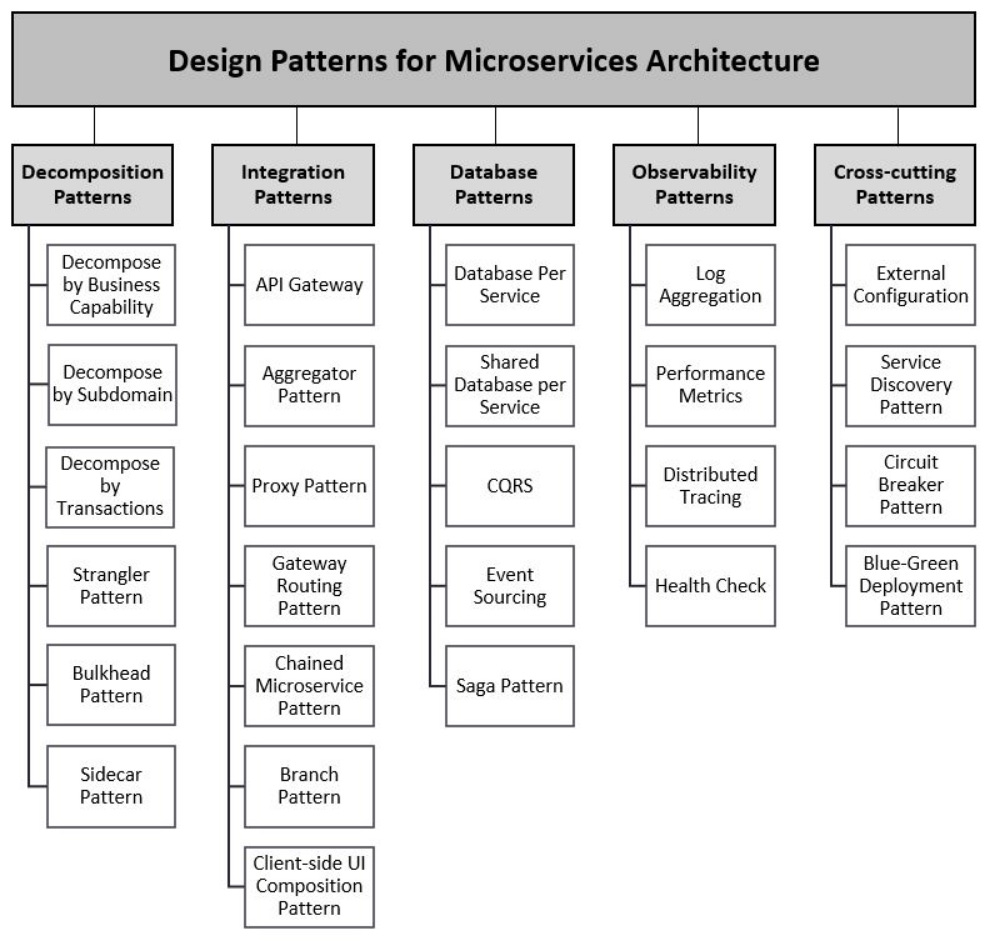
Here are some popular Microservice design patterns that a programmer should know:
Service Registry
Circuit Breaker
API Gateway
Event-Driven Architecture
Database per Service
Command Query Responsibility Segregation (CQRS)
Externalized Configuration
Saga Pattern
Bulkhead Pattern
Backends for Frontends (BFF)
10 Battle-Tested Microservices Patterns from Real-World Applications
Here is a list of popular Microservices design patterns that every developer should know and learn if they are working in Microservices or breaking their monolithic application into Microservices to separate code, data, and interfaces:
1. Service Registry Pattern in Microservices
The Service Registry Pattern provides a central repository to discover Microservices by name.
It is a microservice architecture pattern that enables services to discover other Microservices and communicate with each other.
In this pattern, a central service registry or directory is used to keep a record of the available services and their locations.
Microservices can register themselves with the registry, and other Microservices can look it up to find the locations of the required services.
For example, suppose we have a large e-commerce website that consists of many microservices, such as an order service, a payment service, a shipping service, and a customer service.
Each of these services has its own REST API that other services can use to communicate with it.
To make it easier for these services to discover each other, we can use the Service Registry Pattern.
We can set up a service registry, such as Consul or Eureka (Spring Cloud provides this), that maintains a list of all the available services and their endpoints.
When a service starts up, it can register itself with the registry by providing its name and endpoint.
For example, the order service might register itself as “order-service” with an endpoint of “http://order-service:8080".
Other services that need to communicate with the order service can then look up its endpoint in the registry using its name.
For instance, the payment service might look up the “order-service” endpoint in the registry to send payment information to the order service.
Similarly, the shipping service might look up the “order-service” endpoint in the registry to get shipping information for an order.
This way, each service can be developed and deployed independently, without hard-coding the endpoints of other services in its code.
The Service Registry Pattern enables the services to locate each other dynamically, making the system more flexible and resilient to changes.
2. Circuit Breaker Pattern
As the name suggests, the Circuit Breaker pattern prevents cascading failure by breaking the circuit and enables applications to continue functioning when one or more services fail.

 | A guest post by
|