
Monolith vs Microservices vs Serverless — Which Software Architecture Should You Choose?

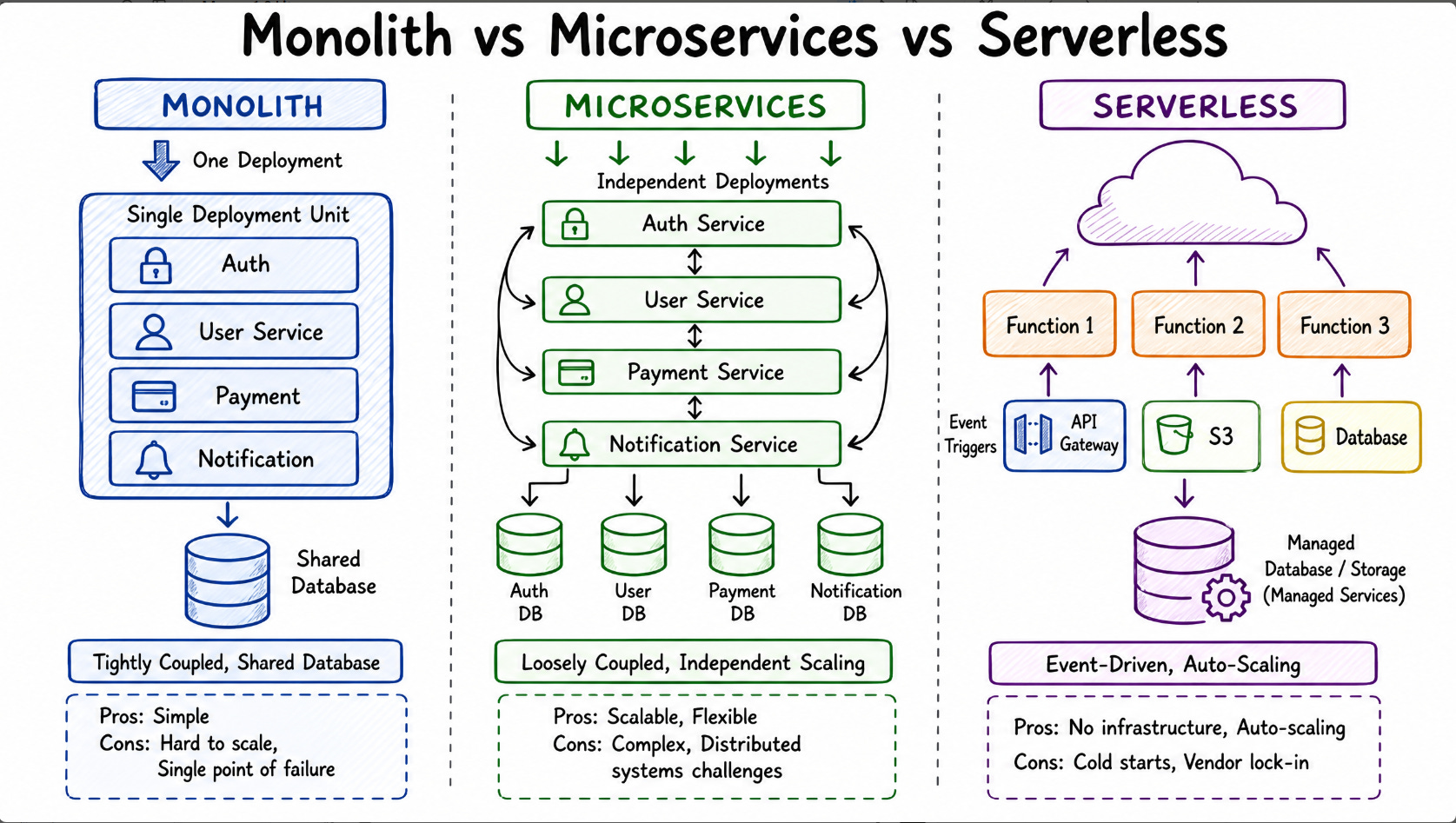
Hello friends, Software architecture has evolved dramatically over the past two decades.
Not long ago, almost every application was built as a monolith. Then came microservices, promising independent deployments and better scalability.
More recently, serverless computing has emerged, allowing developers to focus purely on writing code without worrying about infrastructure.
With so many architectural choices available, one question comes up repeatedly:
Which architecture should you choose?
The truth is that there isn’t a one-size-fits-all answer. Each architecture has its strengths, weaknesses, and ideal use cases.
In this article, we’ll compare Monolithic, Microservices, and Serverless architectures, explain how they work, discuss their pros and cons, and help you decide which one is best for your next project.
What is a Monolithic Architecture?
A Monolithic Architecture is the traditional way of building applications.
Everything is packaged into a single application:
User Interface
Business Logic
Authentication
Database Access
APIs
All components are developed, tested, and deployed together.
                +-----------------------+
                |   Monolithic App      |
                |-----------------------|
                | User Management       |
                | Product Catalog       |
                | Orders                |
                | Payments              |
                | Notifications         |
                +-----------------------+
                         |
                    Single Database
Examples include many applications built using:
Spring Boot
Django
Ruby on Rails
Laravel
ASP.NET MVC
Advantages of Monolithic Architecture
1. Simpler Development
Everything lives in one codebase.
Developers can navigate the project easily without switching between repositories.
2. Easy Testing
Running integration tests is much simpler because everything executes inside the same application.
3. Easier Deployment
One application.
One deployment.
One CI/CD pipeline.
4. Better Performance
Components communicate through method calls instead of network requests.
That means:
Lower latency
Faster execution
Less serialization
5. Lower Operational Cost
You don’t need:
Kubernetes
Service Discovery
API Gateway
Distributed Tracing
Operations remain relatively simple.
Disadvantages of Monolithic Architecture
As applications grow:
Builds become slower.
Deployments become riskier.
Scaling individual components becomes impossible.
Large codebases become difficult to maintain.
Multiple teams start stepping on each other’s code.
Eventually, the application becomes difficult to evolve.
What are Microservices?
Microservices split an application into multiple independent services.
Each service owns:
It’s business logic
Its database
Its deployment
Its lifecycle
For an e-commerce system:
               API Gateway
                     |
     ---------------------------------
     |       |        |       |       |
 Orders  Users  Inventory Payment Notification
     |       |        |       |       |
    DB      DB       DB      DB      DB
Each service can be developed independently.
Advantages of Microservices
Independent Deployment
You can deploy only the Payment Service without redeploying Orders.
Independent Scaling
Suppose only search traffic increases.
You can scale:
Search Service

10 instances
while keeping
Payment Service

2 instances
Saving infrastructure costs.
Better Team Ownership
Large organizations can assign dedicated teams.
For example:
Team A → Payments
Team B → Orders
Team C → Authentication
Each team owns its service.
Technology Flexibility
One service could use:
Java
Another:
Go
Another:
Python
This isn’t always recommended, but it’s possible.
Better Fault Isolation
If the Recommendation Service crashes,
your checkout system can continue operating.
Disadvantages of Microservices
Microservices solve scaling problems—but introduce many new ones.
Increased Complexity
Now you need:
API Gateway
Service Discovery
Monitoring
Distributed Logging
Distributed Tracing
Container Orchestration
Network Latency
Instead of:
Method Callyou now have
HTTP
gRPC
Kafka
RabbitMQ
Network calls are always slower.
Harder Debugging
One request may travel across:
Gateway

↓

Order

↓

Inventory

↓

Payment

↓

Shipping
Finding failures becomes much harder.
Higher Infrastructure Costs
Every service requires:
Container
Monitoring
Logging
CI/CD
Infrastructure grows rapidly.
Distributed Transactions
Maintaining consistency across services requires patterns like:
Saga
Event Sourcing
Outbox Pattern
These are much more complicated than traditional database transactions.
What is Serverless Architecture?
Serverless takes infrastructure management one step further.
