
The Real Difference Between SAGA and CQRS That Most Architects Get Wrong
The Dangerous Mistake Most Developers Make with SAGA and CQRS

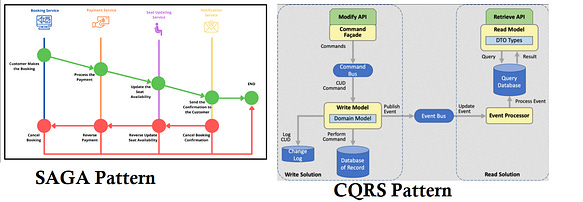
Hello folks, if you have heard about the SAGA pattern and CQRS pattern in the Microservice world and are wondering what they are and when to use them, then you are at the right place. The difference between SAGA and CQRS patterns is one of the common questions on Java interviews.
Both SAGA Pattern and CQRS are both popular patterns used in microservices architecture, but they serve different purposes.
The main difference between SAGA and CQRS is that SAGA focuses on the transactional consistency of the system, while CQRS focuses on the scalability and performance of the system, but there is much more to learn about them, which you will find in this article.
In the past, I have mentioned the SAGA Pattern when I shared 50 Microservice Interview Questions for beginners and experienced developers and 10 essential Microservice design principles, and in this article, In this article, I will share the difference between the two and when to use the SAGA and CQRS patterns in Microservices.
By the way, if you are new to Microservice architecture or just want to revise key Microservice concepts and are looking for resources, then here are a few online courses you can join:
Master Microservices with Spring Boot and Spring Cloud [Udemy]
Building Scalable Java Microservices with Spring Boot [Coursera]
Developing Microservices with Spring Boot [Educative]
Master Microservices with Java, Spring, Docker, Kubernetes [Udemy]
This list includes both video and text-based courses as well as project-based courses for hands-on learning. You can join one or a couple of them to revise Microservices concepts. If you need more choices, you can see the articles below:
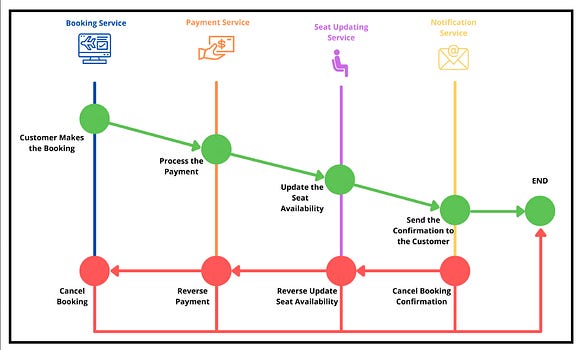
What is the SAGA Pattern in Microservice Architecture?
The SAGA pattern is used to manage transactions across multiple services. It ensures that each service involved in a transaction commits or rolls back its part of the transaction, even if other services fail.
For example, in an e-commerce application, when a user initiates an online purchase, and this involves multiple services like payment processing, order management, and shipping.
The SAGA pattern can be used to ensure that if any of these services fail, the transaction is rolled back, and the user’s money is refunded.
What is the CQRS Pattern in Microservices? What Problem does it solve?
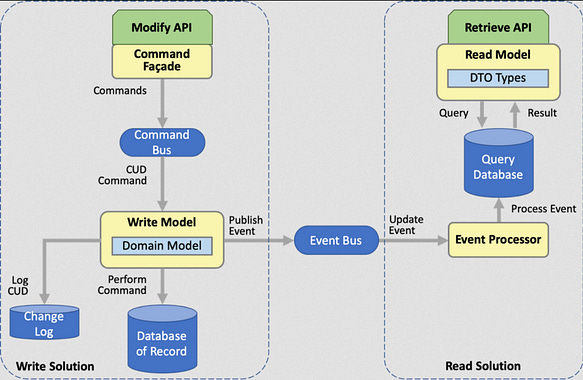
The CQRS (Command Query Responsibility Segregation) pattern is used to separate the read and write operations of an application into different models. It allows for different models to be optimized for their respective tasks.
For example, consider a banking application where users can view their account balance, transaction history, and make transfers. The read operations (like view account balance) can be optimized for high availability and low latency, while the write operations (e.g., make a transfer) can be optimized for data consistency and accuracy.
By separating the read and write operations, we can choose the appropriate storage and processing mechanisms for each.
Here is what a CQRS pattern looks like in Microservice architecture:
In summary, SAGA and CQRS are two different design patterns used in microservices architecture.
SAGA is used to manage transactions across multiple services, while CQRS is used to separate the read and write operations of an application into different models.
Difference between SAGA and CQRS Design Pattern in Microservice Architecture?
Now that you know the basic difference between SAGA and CQRS Pattern, let’s see more differences between them. Sure, here is a tabular comparison between SAGA and CQRS patterns in microservices:
1. What problemdo they solve?
SAGA is a pattern used for managing a sequence of distributed transactions, where each transaction updates data in multiple services, while CQRS is a pattern that separates the read and write operations in a system, using separate models for each.
2. Functionality
SAGA is used to ensure data consistency across multiple microservices when a business transaction requires updates to multiple services, while CQRS pattern is used to improve system scalability, performance, and availability by separating read and write operations and optimizing each separately.
3. Working
SAGA coordinates transactions using a series of compensating transactions that roll back changes made by the previous transaction if an error occurs. On the other hand, CQRS uses a different model for read and write operations. The write model is optimized for data modification, while the read model is optimized for querying and data retrieval.
4. Consistency vs Scalability
SAGA is a solution for maintaining data consistency in a distributed system, where data is spread across multiple services. On the other hand, CQRS is a solution for scaling up a system by separating read and write operations and using different models for each.
5. Complexity
SAGA Pattern can be complex to implement and manage, as it involves coordinating multiple transactions across multiple services. While CQRS can simplify the management of complex systems by separating the read and write operations and using optimized models for each.
6. When to use?
The SAGA pattern is best suited for scenarios where multiple microservices need to be updated as part of a single business transaction. While CQRS is best suited for scenarios where read and write operations are heavily used and need to be optimized separately.
SAGA pattern is typically used in systems that require strong transactional consistency, such as financial systems, while the CQRS pattern is used in systems that require high scalability and performance, such as social media platforms.
7. Implementation
SAGA pattern can be implemented using either the choreography or orchestration approach, while the CQRS pattern is typically implemented using event sourcing.
Java and Spring Interview Preparation Material
Before any Java and Spring Developer interview, I always used to read the following resources
Grokking the Java Interview
Grokking the Java Interview: click here
I have personally bought these books to speed up my preparation.
You can get your sample copy here, check the content of it, and go for it
Grokking the Java Interview [Free Sample Copy]: click here

If you want to prepare for the Spring Boot interview you follow this consolidated ebook, it also contains microservice questions from spring boot interviews.
Grokking the Spring Boot Interview
You can get your copy here — Grokking the Spring Boot Interview

That’s all about the difference between the SAGA Pattern and the CQRS design Pattern in Microservices architecture. The key difference between SAGA and CQRS is that SAGA focuses on the transactional consistency of the system, while CQRS focuses on the scalability and performance of the system
It’s also important to note that both patterns can be used together in a microservices architecture to achieve different goals.
In fact, both SAGA and CQRS patterns can be used together in a microservice architecture to achieve both strong transactional consistency and high scalability and performance.
However, this can add additional complexity to the system, so make sure you analyse the situation and the pros and cons before using SAGA or the CQRS Pattern.
By the way, these are just two of the many microservice design patterns that are available, which you can learn on your own. I will also be sharing more patterns in the future.
Microservices Learning Material and Resources
If you are new to Microservice architecture or just want to revise key Microservice concepts and are looking for resources, then here are a few online courses you can join:
Master Microservices with Spring Boot and Spring Cloud [Udemy]
Building Scalable Java Microservices with Spring Boot [Coursera]
Developing Microservices with Spring Boot [Educative]
Master Microservices with Java, Spring, Docker, Kubernetes [Udemy]
This list includes both video and text-based courses as well as project-based courses for hands-on learning. You can join one or a couple of them to revise Microservices concepts.