
Master These 25 System Design Concepts to Become a Better Software Engineer
If you want to become good at system design, learn these concepts:


Want to learn System Design in Depth? Join ByteByteGo now for visual learning. They are also offering a rare 50% discount now on their lifetime plan
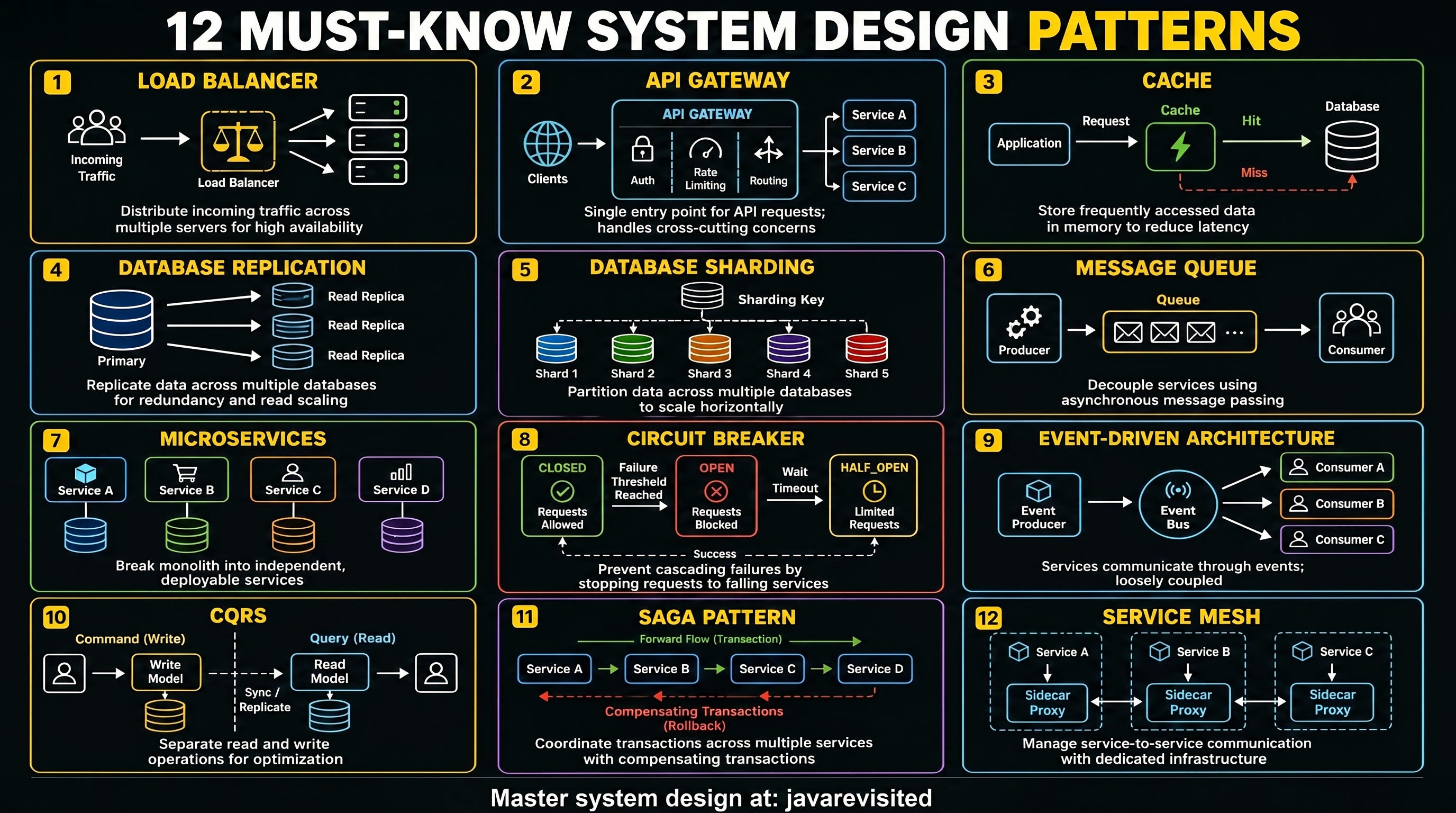
Hello everyone, if there’s one skill that consistently separates senior engineers from junior developers, it’s System Design.
Whether you’re preparing for a FAANG interview, designing scalable applications, or simply trying to become a better backend engineer, understanding system design is no longer optional. Modern software isn’t built by writing classes and APIs alone—it’s about designing systems that are scalable, reliable, secure, and resilient.
The good news? You don’t need to learn everything at once.
Start by mastering one concept at a time. Over the years, I’ve written detailed articles explaining many of the most important system design concepts with practical examples and diagrams. Here are some of the ones I recommend every developer should understand.
API Design & Networking
API Gateway vs Load Balancer
Understand how incoming requests are routed and why both components play different roles in a distributed system.

Reverse Proxy vs Forward Proxy
Learn how proxies improve security, performance, and privacy, and when to use each type.
REST vs gRPC
Compare the two most popular communication protocols for modern distributed applications and understand when each is the better choice.
Scaling & High Availability
Horizontal Scaling vs Vertical Scaling
Discover the advantages and trade-offs between scaling up a single server and adding more servers.
Horizontal vs Vertical Scaling Made Simple

Tired with watching YouTube videos on System Design but still failing on Interviews? Join ByteByteGo now for a structured preparation. Get 50% discount now on their lifetime plan.
Caching Strategies
Learn how caching improves application performance and explore common cache patterns used in production systems.
Database Scaling
Explore techniques like read replicas, partitioning, and indexing to handle growing data and traffic.
Database Replication vs Sharding
Understand the difference between increasing availability with replication and improving scalability with sharding.
Failover & Disaster Recovery
Learn how production systems recover from failures and continue serving users during outages.
Heartbeats & Health Checks
See how distributed systems detect unhealthy services and automatically replace failed instances.
Architecture Patterns
Microservices vs Monolithic Architecture
Understand the strengths, weaknesses, and trade-offs of both architectural styles.
Microservices vs Monolith (Deep Dive)
A more detailed comparison with practical guidance on choosing the right architecture.
CQRS (Command Query Responsibility Segregation)
Learn how separating read and write operations improves scalability and performance.
Event-Driven Architecture
Understand how asynchronous communication helps build scalable, loosely coupled systems.
Saga Pattern
See how distributed transactions work in microservices without relying on traditional database transactions.
Circuit Breaker Pattern
Learn how to prevent cascading failures and build resilient microservices.
Messaging & Distributed Systems
How Apache Kafka Works
Discover why Kafka is capable of processing millions of events per second and why it’s widely used for real-time data streaming.
Kafka vs RabbitMQ vs ActiveMQ
Compare the strengths and ideal use cases of today’s most popular messaging platforms.
Message Queues
Learn the fundamentals of asynchronous communication and why message queues are essential in distributed systems.
Consistent Hashing
Understand the technique that powers scalable distributed caches and databases by minimizing data movement.
Leader Election (Raft & Paxos)
Explore how distributed systems choose a leader and maintain consistency across multiple nodes.
Security & Authentication
JWT vs OAuth vs SAML
Understand the differences between authentication, authorization, and identity federation.
How Single Sign-On (SSO) Works
Learn how users can authenticate once and securely access multiple applications.
JWT vs Session-Based Authentication
Compare two common authentication mechanisms used in modern web applications.
Reliability & Performance
Rate Limiting
Learn how applications prevent abuse, control traffic spikes, and protect backend services.
Idempotency
Discover why payment systems and APIs rely on idempotent operations to safely handle retries without creating duplicate requests.
Final Thoughts
System Design isn’t about memorizing diagrams or patterns. It’s about understanding why systems are designed the way they are and knowing which solution fits a particular problem.
You don’t need to master all 25 concepts in a week. Pick one or two each week, read the articles, experiment with the ideas, and try applying them in your own projects. Over time, you’ll build the intuition needed to design scalable, reliable, and maintainable systems—and you’ll also be much better prepared for system design interviews.
Happy learning!
Other System Design Articles you may like


 | A guest post by
|