How the Saga Pattern Solves Distributed Transaction Problems?
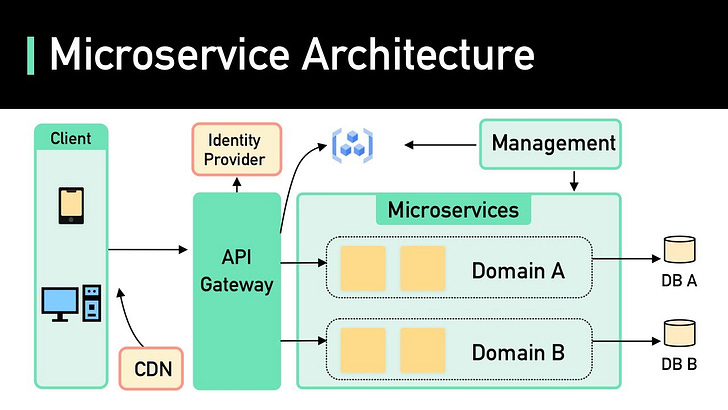
Saga pattern explained in context of Microservices architecture

Hello friends, if you are working in a Java Microservice or preparing for a Java developer interview where Microservice skills are needed, then you must prepare about the Saga or SAGA Pattern.
SAGA is an essential Microservice pattern that aims to solve the problem of long-lived transactions in Microservice architecture. It’s also one of the popular Microservice Interview Questions that is often asked to experienced developers.
Since Microservice architecture breaks your application into multiple small applications, a single request is also broken down into multiple requests, and there is a chance that some parts of requests succeed and some parts fail. In that case, maintaining data consistency is hard.
If you are dealing with real data, like placing an order on Amazon, then you must handle this scenario gracefully so that if payment fails, then the inventory reverts to its original state, as well as order is not shipped.
In this article, I will explain what is SAGA Pattern is. What it does, which problem it solves, as well as the pros and cons of the SAGA Pattern in a Microservice architecture.
What is the SAGA Design Pattern? What problem does it solve?
The SAGA (or Saga) pattern is a Microservice design pattern for managing data consistency in distributed systems.
It provides a way to handle long-lived transactions that are composed of multiple steps, where each step is a separate database operation.
The main idea is to capture all the steps of the transaction in a database so that in case of failure, the system can roll back the transaction to its initial state.
The SAGA pattern solves the problem of maintaining data consistency in a distributed system, where it is difficult to guarantee that all operations in a transaction are executed atomically, especially in case of failures.
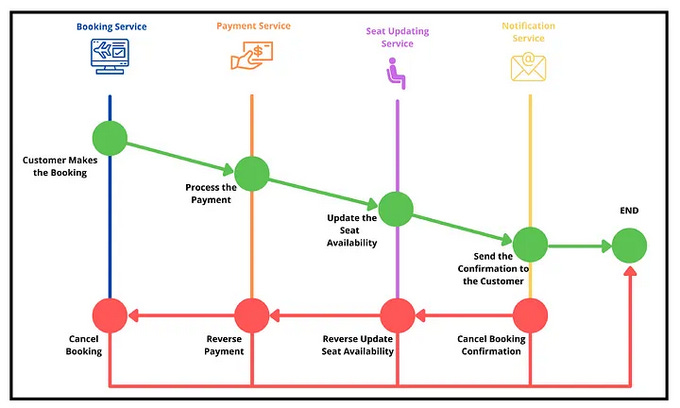
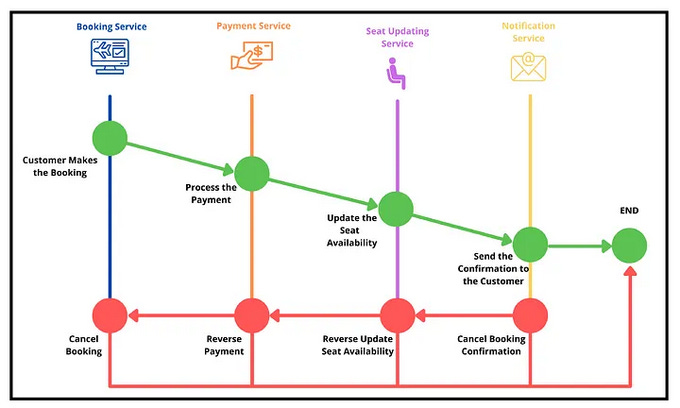
One of the popular examples of the SAGA pattern is an e-commerce transaction like placing an order on Amazon or Flipkart, where an order is placed, payment is deducted from the customer’s account, and items are reserved in the inventory.
If any of these steps fail, the previous steps are rolled back to ensure consistency. For instance, if the payment fails, the reservation of items is canceled.
SAGA pattern solves the problem of maintaining consistency in a transaction involving multiple steps that may or may not succeed.
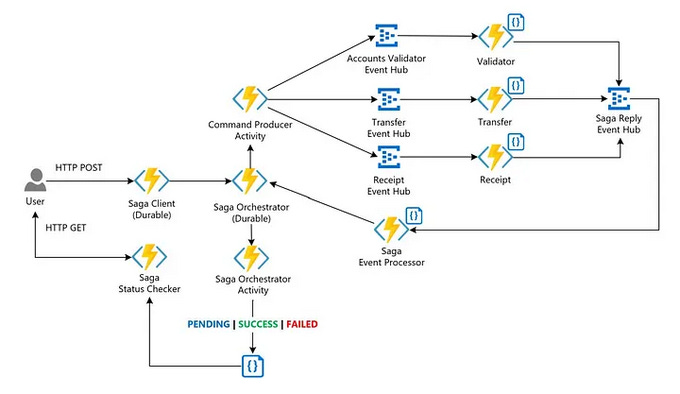
Here is another Microservice architecture diagram to demonstrate how the SAGA Pattern works:
Pros and Cons of SAGA Design Pattern in Microservices Architecture
Whenever we learn a pattern, we should learn its pros and cons as it helps us to understand patterns better and also helps us to decide when to use them in our application:
Here are some advantages and disadvantages of the SAGA pattern in Microservice:
Advantages:
Here are some advantages of using the SAGA Design pattern in Microservice architecture:
It’s easy to implement complex transactions across multiple microservices.
Handles failures gracefully and ensures data consistency.
Increases system resilience and robustness.
Avoids data inconsistencies and lost updates.
Provides a clear and well-defined process for compensating transactions.
Disadvantages
Here are some disadvantages of using the SAGA Design pattern in Microservice architecture:
It’s hard to implement and maintain, its also difficult to monitor and debug
You will have the overhead of storing and managing the state of sagas.
It also comes with Performance overhead due to the need to manage transactions across multiple microservices.
Your application will also suffer from increased latency due to the need for multiple round-trips between microservices.
There is no standardization in implementing sagas across different microservices. It would be better if frameworks like Spring Cloud or Quarkus natively support this pattern in the future.
How to Implement the SAGA Pattern in a Microservices Architecture?
The SAGA pattern can be implemented in a Microservices architecture by breaking down a complex business transaction into multiple, smaller, independent steps or services.
Each step would communicate with its corresponding Microservice to complete a part of the transaction.
If any step fails, the system will initiate a compensating transaction to undo the previous steps.
The coordination of these steps can be achieved by using a database, message queue, or coordination service to store the state of the transaction and to trigger compensating transactions.
This way, the system can ensure eventual consistency and handle failures gracefully.
If you are wondering whether any Java Microservice framework can provide support for the SAGA Pattern?
Then, unfortunately, there is no specific Microservice framework that provides direct support for the SAGA pattern.
However, you can implement the SAGA or Saga Pattern using libraries and frameworks such as Apache Camel or Spring integration, along with technologies like Apache Kafka, event sourcing, and message-driven architecture.
Java and Spring Interview Preparation Material
Before any Java and Spring Developer interview, I always used to read the following resources
Grokking the Java Interview: click here
I have bought these books to speed up my preparation.
You can get your sample copy here, check the content of it, and go for it
Grokking the Java Interview [Free Sample Copy]: click here

If you want to prepare for the Spring Boot interview you follow this consolidated eBook, it also contains microservice questions from spring boot interviews.
Grokking the Spring Boot Interview
You can get your copy here — Grokking the Spring Boot Interview

Thank you for reading my article. That’s all about SAGA design Patterns in Microservice Architecture. It’s one of the complex yet important patterns to learn, and it's particularly important from an interview perspective.
Even if you have not implemented the SAGA pattern in your project, it’s worth noting that the problem of managing distributed transactions and data consistency is a genuine problem, and as an experienced developer, you should know how to solve it in a Microservice architecture.
By the way, if you are new to Microservice architecture or just want to revise key Microservice concepts and are looking for resources, then here are a few online courses you can join:
Master Microservices with Spring Boot and Spring Cloud [Udemy]
Building Scalable Java Microservices with Spring Boot [Coursera]
Developing Microservices with Spring Boot [Educative]
Master Microservices with Java, Spring, Docker, Kubernetes [Udemy]
This list includes both video and text-based courses as well as project-based courses for hands-on learning. You can join one or a couple of them to revise Microservices concepts.
Other Microservices articles you may like